(1) I recently finish a B.S. on Architecture
and my graduation is on May, 2012. I have been accepted on BAC for a
Master on Architecture I will start it next fall. I have been looking, hunting
and searching for a job in an architectural firm for over a year. I have
multiple webpage where I look for job every day, I received job alerts
every day and I go to different architectural firm webpage and whenever they
post jobs that I am qualified for I apply, but they never get back to me. Now,
my question is: is there any future in Architecture??? I am asking this,
because when I finally find a job post it requires 5 to 10 years of experience.
I can see any future in this career if there is not chance to inexperience
talent when we do not have the opportunity to get experience.
(2) I currently working on an engineering
company creating BIM 3D models. The job is not bad at all, but at the end, will
this job experience creating BIM 3D models payoff to get a job or
an internship within an architectural firm? I love
architecture since I remember, but if I will not have a chance to became
license architect, is it worth to owe 100k on students loans and spend all the
time that study architecture requires? Right now I am very disappointed I
will definitively finish my M.arch, but we recently graduated architecture
students really need the opportunity within the field and not just for us
for the career itself.
(3) A career that does not get fresh air with
new talents, new ideas and new points of view, will have any future? Most of my
classmates are looking for job and just the 5% have a job in architectural
firm, 10% got a NOT pay internship. I CANNOT afford to work for free
paying gas, rent, food while I am working for free and
all Spence that will result from a M.arch.
(4) However, Architecture is the
most beautiful career I have ever seem and I DO NOT regret all the
time I have spent on it and the time I will spend on it. I will finish my
M.Arch no matter what. Even when I will be the last man standing in a death
end regarding getting experience. At the end all I am wonder: Is there any
future in Architecture???
Architecture(Latinarchitectura,
from the Greekἀρχιτέκτων– arkhitekton, fromἀρχι-"chief" andτέκτων"builder, carpenter, mason")
is both the process and product ofplanning,designingandconstruction.
Architectural works, in the material form ofbuildings, are often perceived as cultural
symbols and asworks of art.
Historical civilizations are often identified with their surviving
architectural achievements.
"Architecture" can mean:
·A general term to
describe buildings and other physical structures.
·The art and science ofdesigningand
erecting buildings and other physical structures.
·The style and method of
design and construction of buildings and other physical structures.
·The practice of thearchitect, where architecture means the
offering or rendering of professional services in connection with the design
and construction of buildings, or built environments.[3]
·The design activity of
the architect, from the macro-level (urban design,landscape
architecture) to the micro-level (construction details and
furniture).
·The term
"architecture" has been adopted to describe the activity of designing
any kind of system, and is commonly used in describinginformation
technology.
In relation to buildings, architecture has to
do with the planning, designing and constructing form, space and ambience that
reflect functional, technical, social, environmental, and aesthetic
considerations. It requires the creative manipulation and coordination of
material, technology, light and shadow. Architecture also encompasses the
pragmatic aspects of realizing buildings and structures, including scheduling,
cost estimating and construction administration. As documentation produced by
architects, typically drawings, plans and technical specifications,
architecture defines thestructureand/orbehaviorof
a building or any other kind ofsystemthat
is to be or has been constructed.
http://en.wikipedia.org/wiki/Architecture
READING 2
Books Every
Architect Should Read: Seeing Things as You Have Never Seen Them Before
If you read a novel, you are connecting directly to the thing that
interests you, but if you read an architecture book, you are not. What books
about architecture have to offer is vicarious experience. Even the best
architecture books, like museum exhibitions about architecture, leave us one
layer removed from the reality of seeing a building, the experience of walking
around it, the feeling of being inside it.
Still, for all that we like
to believe that in architecture—as the great Latin phrase res ipsa
loquitur has it—the thing itself speaks, not all buildings do. Some of
them need help in speaking, in making us understand what they have to say. So the
first role of books about architecture is to interpret and explain: to be, in
effect, the label on the museum wall, or the note in the concert program.
This is why I have always had a certain weakness for architectural
guidebooks, which proceed from the assumption that the subject matter is the
buildings themselves, and that the role of the book is to offer intelligent
discussion of the architecture that is in front of you, as if your meanderings
were accompanied by a knowledgeable and cultivated friend. The best guidebooks,
like the best friends, have points of view, and they are clear about what they
like and what they dislike.
Many years ago, when I read
the late Ian Nairn’s guides to London and Paris (called, with an endearing
presumption, Nairn’s London and Nairn’s Paris),
and carried them around the streets with me, I felt that I was getting to know
a person as much as I was getting to know a city’s architecture. You could see
that Nairn was made of equal parts of amiability and disagreeableness, that he
could swoon, but only over the very finest things; that he could take joy in
the most ordinary streetscape if it could be shown to make daily life better;
and that he could always be counted on to prefer the work of an eccentric
genius like Nicholas Hawksmoor over that of a sane and rational architect like
Christopher Wren. He did more than guide me around the streets of London. He
helped me understand the profundity of Hawksmoor and Sir John Soane, whose
house in Lincoln’s Inn Fields Nairn called “as deep as St. Paul’s dome is wide;
an experience to be had in London as nowhere else, worth traveling across a
continent to see in the same way as the Sistine Chapel”—a line I remember three
decades after reading it. Nairn shaped my sensibility, and my sense of London
is inextricably bound up in his.
Nairn’s books had no small
degree of influence on my own first book, The City Observed: An
Architectural Guide to Manhattan, and on the work of many other writers.
Time passes, and things change, which makes architectural guidebooks more
perishable than many other kinds of books; the London and Paris that Nairn
described are no more present today than is the New York of the late 1970s that
I wrote about. These books and others like it—Charles Moore’s The City
Observed: Los Angeles comes particularly to mind—are out of date in
the sense that they cannot function precisely as they once did, but they remain
a great joy to read.
My point is that one or more
architectural guides to treasured places, current or not, belong in every
architect’s library, whether or not you ever intend to hold them in your hand
as you walk around. The more personal, the better, and don’t be put off by
generic-sounding titles: the AIA Guide to New York City, which just
came out in a new edition, may look like a reference book, but it is filled
with sharp observations, and there is a decent amount of wit among the
encyclopedic listings. Some of the other guidebooks worth having: An
Architectural Guide to Los Angeles, by David Gebhard and Robert
Winter; Chicago’s Famous Buildings, by Franz Schulze and Kevin
Harrington; and Venice for Pleasure, by J. G. Links.
If architectural guidebooks
as a genre can bring you closer to the reality of architecture than most other
kinds of books, they nonetheless make only the barest beginning of a basic
reading list. Architecture, after all, is about everything—it is a product of
culture and money and politics as well as aesthetics, and sometimes there is
more insight about architecture to be found in books that are ostensibly about
something else. Can any work of architectural history provoke you to think
about the relationship between the physical form of the city and the social
life that goes on within it as powerfully as The Age of Innocencedoes?
Edith Wharton makes manifest the connections between the great houses of New
York at the end of the 19th century and the human dramas that occurred inside
and around them; you cannot read this great novel and emerge with a better feel
for the brick and stone of 19th-century New York than you will get from almost
any work of architectural history, and for me there is a special pleasure in
sensing the intimate connection between the physical form of architecture and
human interaction. Wharton makes you see architecture not as a simple
catalyst—she is far too subtle for that—but as much more than a neutral
setting.
It doesn’t have to be Edith
Wharton, or Henry James in Washington Square, who shows you how
architecture can affect the life that goes on within it, and, in turn, how much
architecture is a product of social and cultural mores. Mr. Blandings
Builds His Dream House, by Eric Hodgins, makes the point even more
directly, if in nearly farcical fashion, as the suburban ideal of the middle of
the 20th century proves to be something of a nightmare. (It is light
entertainment compared to Henry James, but it is a humbling book for
architects, which is all the more reason they should read it.)
My belief that novels in
which architecture plays a significant role should be high on any architect’s
reading list—and there are many more than the three I have mentioned—does not
extend to the most famous one of all, The Fountainhead, which
purports to celebrate the architect but in fact turns him into a cartoon of an
arrogant monster. In general, I am not particularly high on works of fiction in
which an architect is the main character, since most of them tend to offer
rather less insight into architecture than do so many works that are about
other kinds of people, and which approach the subject of architecture more
obliquely. Even as great a work as Ibsen’s play The Master Builder is
not the place to go for insight into architecture.
Biographies of architects
have not, by and large, been a particularly enlightening genre, with the
ongoing exception of Frank Lloyd Wright, whose life of high drama has led
Brendan Gill, Ada Louise Huxtable, and Meryle Secrest to be only the most
recent of the many who have written a version of Wright’s life story. Huxtable
in particular deftly ties Wright’s work and his life together without
exaggerating the connections between the two. Wright was not immune to his own
attraction as a subject, and his Autobiography, if wildly
hyperbolic and free and loose in its use of facts, is one of the most exciting
books about architecture that you can read. Franz Schulze’s Mies van
der Rohe: A Critical Biography and Philip Johnson: Life and
Workalso rise above the limitations of the genre, as does Nicholas Fox
Weber’s Le Corbusier: A Life, though in all of these cases one may
wonder how much a chronicle of an architect’s bedmates will add to your
understanding of his work.
A list of books that every architect ought to read cannot consist
entirely of guidebooks, novels, and biographies, of course. But I’m not sure
that it need include histories and standard reference books, either. There are
plenty of excellent architectural dictionaries and the like, and when you need
to know the difference between a pilaster and a pediment, or what the Queen
Anne style was, there is nothing better. They are books every architect should
have. But that is not the same as books every architect should read.
What every architect should read are the books that ruminate about what architecture
is and how it works, the books that make you think about it in another way, the
books that tell you how the world has shaped architecture, and how
architecture, in turn, has affected the world. The greatest buildings, like art
and music and literature, can be interpreted in multiple ways. They look
different to you than they do to me, and they mean different things to you and
me; they meant different things at different times in the past, and they will
mean different things in the future. As there is no end to what can be said
about Beethoven and Mozart, there is no end to what can be said about the work
of Michelangelo and Palladio and Borromini and Le Corbusier and Frank Lloyd
Wright and Louis Kahn.
The books every architect should read are the books that give you more
than the information you can find in textbooks and dictionaries and style
guides, useful (and even, on occasion, entertaining) as such books can be. The
books I value most are the books that are personal, the books whose authors
make you see things as you have never seen them before, the books whose prose
strikes you as fresh no matter how many times you have read it before. As it is
hard to turn away from the allure of a well-composed facade—and why should
you—I find that elegant prose about architecture exerts an equal pull. If there
is anything that ties together writers like John Summerson, Vincent Scully,
Michael Sorkin, Charles Moore, John Brinckerhoff Jackson, Geoffrey Scott, and Lewis
Mumford, it is that they all use the English language with distinction and
grace, sometimes even with majesty. Each of them loves words, and loves the
connection between words and architecture. They have different things to say
about architecture, and often don’t agree with one another. But they all teach
us much about buildings and cities and community, and they do it in writing
that is as appealing as the best of the architecture that they describe.
John Summerson’s Heavenly
Mansions and Other Essays on Architecture, first published in 1963, is a
case in point. Summerson takes on Christopher Wren in “The Mind of Wren,” an
essay that brilliantly dissects the architect in terms of his relationship to
the intellectual and social currents of 17th-century England. “Wren carried
empiricism into architecture just as Locke carried it into philosophy,”
Summerson writes. “In his towers and spires we can see the triumphs—and the
disasters—of a fancy controlled empirically, not intuitively. In St. Paul’s
success and failure are inextricably woven, although the ultimate grandeur of
the whole, as a sheer monument of intellectual self-reliance, is beyond all
criticism or praise.” In his quest to set Wren in an intellectual and cultural
context, Summerson does not ignore Wren’s buildings themselves; in fact, he
describes them with utter clarity, often in phrases as evocative as the rest of
his prose.
Summerson’s “The Past in
the Future,” also in Heavenly Mansions, is perhaps the finest essay
on historic preservation ever written. He talks of the relative ease of keeping
art, literature, and music alive, and then says: “But old buildings are
different. Like divorced wives they cost money to maintain. They are often
dreadfully in the way. And the protection of one may exact as much sacrifice
from the community as the preservation of a thousand pictures, books or musical
scores. In their case only, we are brought face to face with decisions on
values. And these values are complicated."
Vincent Scully is as
distinctive a stylist as Summerson, and his Modern Architecture and
Other Essayscontains a wide-ranging sampling of his work, including his
memorable essay “The Death of the Street,” an analysis of postwar Park Avenue
in New York City in which Scully first comes to terms with the anti-urbanism of
orthodox modern architecture, and takes his first step back toward an embrace
of traditional urban planning. The book makes a good introduction to Scully,
although I admit to being partial to hisAmerican Architecture and Urbanism,
published in 1969, which had an enormous influence on me as a student, perhaps
because it is a single, long, unbroken cavalcade of words and images, the book
that most closely echoes his charismatic lecture style. And I was deeply moved
by Scully’s sense of urgency about the urban condition. He called the effort to
rescue the American city a “labor . . . to which we are all drawn in agony and
love for the whole of the American place and its people, as time runs out on
us, while the curtains flap in the windows of the old brownstones, and the
grasses bend in the water by the gray-shingled houses, and the neo begins to
glow on the lifting plain under the darkening sky.”
Charles Moore’s essay “You
Have to Pay for the Public Life,” first published in 1965 in the Yale
architecture journal Perspecta, and reprinted in a collection of
Moore’s writing of the same title, was the first serious piece of architectural
writing about Disneyland, which Moore viewed as “enormously important and
successful just because it recreates all the chances to respond to a public
environment, which Los Angeles particularly no longer has.” Forty-five years
later, Moore’s analysis is still on point—and it all but predicted the gradual
conflation of the city and the idea of the theme park. It remains one of the
greatest essays written about the decline of the public realm in our time.
Lewis Mumford’s major books
can be turgid, and their earnest tone now comes off more as self-important, but
Mumford’s shorter essays in architecture, most of which ran in The New
Yorker, are masterworks of clarity, with moments of sparkle that do not
exist in his full-length books. The best collection is From the Ground
Up, but The Highway and the City is worth reading as well.
Both are reminders that Mumford saw architecture always as a social art before
he saw it as an aesthetic one, however sharp his eye. He had a troubling
dislike of the chaotic, random aspect of cities that we have learned, in the
post-Jane Jacobs age, to value deeply, and he had an almost naïve belief in the
power of rational thinking to solve urban problems. I disagree with much of
what Mumford said about cities and I only sometimes share his judgments about
individual works of architecture, but I think he is essential to read anyway. His
stately prose is the best reminder we have that architecture exists for a noble
cause.
Architects should read John
Brinckerhoff Jackson’s A Sense of Place, A Sense of Time, Michael
Bierut’sSeventy-nine Short Essays on Design, Michael Sorkin’s Twenty
Minutes in Manhattan, and Alain de Botton’s The Architecture of
Happiness, each its own combination of clarity, warmth, wit, personal
passion, and erudition. There is joy and modesty to all four of these books;
these qualities take a different form in each, but their presence is
unmistakable. These books teach you that architecture is more than the sum
total of buildings; they explore the elusive idea of place, and the connections
between the tiniest objects and the largest places. These books also remind us
that common sense and serious writing are not mutually exclusive. I would say
the same, I think, of a classic book from earlier in the 20th century, Geoffrey
Scott’s The Architecture of Humanism, which architects should also
read. And returning to our own time, an air of refined common sense also
prevails in the work of Witold Rybcynzski, especially The Most
Beautiful House in the World; and in Steen Eiler Rasmussen’s
near-classic, Experiencing Architecture, a book which, along
with The Architecture of Happiness, echoed in my own mind as I
tried to explain architecture in the most basic way in Why Architecture
Matters. Also in the category of Basic Books That Are Not Reference Books,
no architect should be embarrassed to have on his or her bookshelf Round
Buildings, Square Buildings, and Buildings That Wiggle Like a Fish, by
Philip M. Isaacson, a little book, mainly of photographs, that was written for
children but which is one of the best introductions to architecture that anyone
could read.
For all of this, I don’t
want to suggest that prose style is everything. Two of the most important books
on architecture that I have ever read are more notable for the freshness of
their thinking than the energy of their prose. Like many people, I did not see
architecture the same way after reading Robert Venturi’sComplexity and
Contradiction in Architecture, and I did not see cities the same way after
reading Jane Jacobs’s The Death and Life of Great American Cities—both
truly seminal works that have helped millions of people understand the limits
in the purism of orthodox modernism. They are books that every architect must
read, no matter whether the words dance off the page.
Civilization as we know it
began between North Africa and western Asia in the land known as
Mesopotamia. The first civilization that lived there was called
Sumer. Then, other communities began to appear around the
world. In order for these civilizations to grow, they needed shelter
and other buildings to live in and to store resources. This is when
the “house” first appeared. What is a house? What is a
shelter? A shelter is a structure or a natural feature that provides
protection against bad weather, danger, or pests such as insects.
Early man found shelter in
caves and other structures already in nature. But eventually man
started to make his own shelter. One of the first houses was made
like tents; cone shaped and wrapped in leather and animal
furs. These houses were made using stone tools. This era
is known as the Stone Age.
Then houses
gained a more civilized look. These early houses were based on the
tools available and environmental factors, and included structures made of
sandstone and logs. A tree house might have been a shelter at this
time. These houses were the start for the amazing designs and shapes
of human dwellings.
The
time that came later was known as the Middle Ages. This was a time
of castles, knights and kings. Housing went beyond mere shelter and
started to take into account the shape and design of the house. The
monarchy order great castles and cathedrals to be built. Rich people
owned huge estates with beautiful mansions while poor people lived in less
civilized dwellings. This time is known as the
Renaissance. These houses evolved very much into the ones we know
today.
The
Industrial Revolution also played an important role in the evolution of houses. The
number of modern looking houses rapidly multiplied. This was because
of the mass production tat factories allowed. This gave people more
jobs; also, more tools and parts were made available to build houses. The
jobs made people come to the cities, so more buildings for shelter had to be
built.
The first
American houses were built in the thirteen colonies. These houses
were log cabins like the one shown below. Early American settlers
inhabited these log cabins which lasted along time. Then houses
evolved into brick apartments and private mansions. Finally, the
houses in the information age became modern looking and skyscrapers rose in the
cities.
Great
civilizations like the Roman Empire and Greece influenced the way of
architecture forever. Modern shelters reflected the styles of these
ancient civilizations.From the Stone Age to the
present, the style of houses has made a giant leap. From using
structures and resources found in nature, to sleek stylish designs
of the 21st century, the evolution of housing
continues. What the house of the future will look like can partially
be guessed by looking at what has come before, and can be partially imagined by
where it could go.
Most people in ancient China could not afford to live in fancyhouses. They lived in smallhousesmade ofmudbrick, with only one room and a dirt floor, just the way
most people in theRoman EmpireorWest AsiaorAfricalived, and the way most people in the world still live
today. In Northern China, the doors of these houses usually faced south, to
keep out the coldnorth wind.
Hall of Supreme Harmony, Forbidden City (Beijing, 1450 AD)
Rich people had fancier houses, and people also built fancy temples and
palaces. All ancient Chinese architecture was built according to strict rules
of design that made Chinese buildings follow the ideas ofTaoismor otherChinese philosophies. The first design idea was that buildings should be
long and low rather than tall - they should seem almost to be hugging you. The
roof would be held up by columns, and not by the walls. The roof should seem to
be floating over the ground. The second design idea was symmetry: both sides of
the building should be the same, balanced, just asTaoismemphasized balance. Even as early as theShang Dynasty, about 1500 BC, Chinese buildings looked pretty much
like this, with curved tile roofs and long rows of pillars. The palaces of theChou Dynasty, and then theChin Dynasty, continued in this same style.
White
Pagoda (Chengde)
The biggest change in Chinese architecture came during theHan Dynasty, in the 200sBC, when the new religion ofBuddhismfirst came to China from India. Many Chinese Buddhists
began to buildpagodasto keep sacred things in. At first these pagodas were
related toIndianbuildings calledstupas.
When Buddhism became more important in China in the 500sAD, during theThree Kingdomsperiod, architects began to build special Buddhist
temples.
But under theSui Dynasty, in the early 600s AD, the ideas of symmetry and
balance that were important inTaoismbecame more important again.
At the same time, people continued to want Buddhist pagodas. Under theTang dynasty, architects designed even fancier Buddhist pagodas,
with eight sides. One famous eight-sided stone pagoda is the White Pagoda at
Chengde.
Under theSung dynasty, about the year 1000 AD, people wanted their pagodas
to be tall and thin, with high spires. To make them fancier, they had
complicated wooden lattices all around them.
While the MongolYuan dynastyruled China, about 1200-1300 AD, they builtgreat palacesat Beijing, with many huge halls. The great
architectural accomplishment of theMing dynastyin the 1400s was to build the Forbidden City, a huge
palace where the emperors lived. But the Forbidden City's buildings still
follow pretty much the same architectural rules as the palaces of theShang Dynasty, three thousand years earlier.
The Eiffel Tower (French: La Tour Eiffel, [tuʁ ɛfɛl]) is an ironlattice tower located on the Champ de Mars in Paris, named after the engineer Gustave Eiffel, whose company designed and built the tower. Erected in 1889 as the entrance arch to the 1889 World's Fair, it has become both a globalcultural icon of France and one of the most recognizable structures in the world. The tower is the tallest structure in Paris[10] and the most-visited paid monument in the world; 7.1 million people ascended it in 2011. The third level observatory's upper platform is at 279.11 m the highest accessible to public in the European Union and the highest in Europe as long as the platform of the Ostankino Tower, at 360 m, remains closed as a result of the fire of August 2000. The tower received its 250 millionth visitor in 2010.
The tower stands 320 metres (1,050 ft) tall, about the same height as an 81-storey building. During its construction, the Eiffel Tower surpassed theWashington Monument to assume the title of the tallest man-made structure in the world, a title it held for 41 years, until the Chrysler Building in New York City was built in 1930. However, because of the addition, in 1957, of the antenna atop the Eiffel Tower, it is now taller than the Chrysler Building. Not including broadcast antennas, it is the second-tallest structure in France, after the Millau Viaduct.
The tower has three levels for visitors. Tickets can be purchased to ascend, by stairs or lift (elevator), to the first and second levels. The walk from ground level to the first level is over 300 steps, as is the walk from the first to the second level. The third and highest level is accessible only by lift - stairs exist but they are not usually open for public use. Both the first and second levels feature restaurants.
The tower has become the most prominent symbol of both Paris and France, often in the establishing shot of films set in the city.
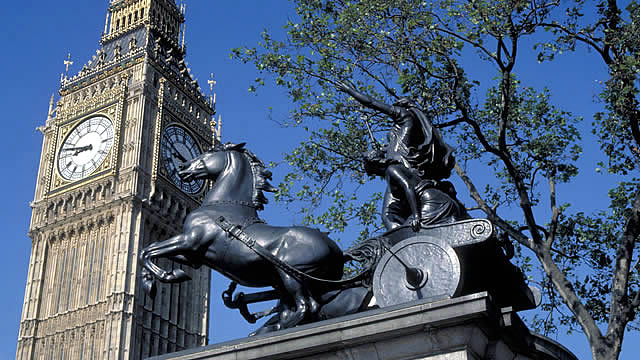
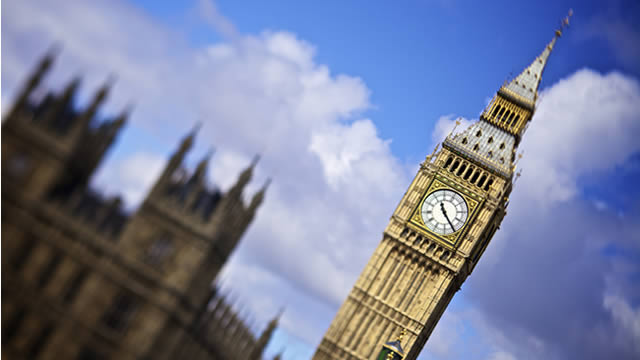
The Houses of Parliament and Elizabeth Tower, commonly called Big Ben, are among London's most iconic landmarks. Technically, Big Ben is the name given to the massive bell inside the clock tower, which weighs more than 13 tons (13,760 kg). The clock tower looks spectacular at night when the four clock faces are illuminated.
Big Ben Facts
Each dial is seven metres in diameter
The minute hands are 4.2 metres long and weigh about 100kg (including counterweights)
The numbers are approximately 60cm long
There are 312 pieces of glass in each clock dial
A special light above the clock faces is illuminated when parliament is in session
Big Ben's timekeeping is strictly regulated by a stack of coins placed on the huge pendulum.
Big Ben has rarely stopped. Even after a bomb destroyed the Commons chamber during the Second World War, the clock tower survived and Big Ben continued to strike the hours.
The chimes of Big Ben were first broadcast by the BBC on 31 December 1923, a tradition that continues to this day.
In June 2012 the House of Commons announced that the clock tower was to be renamed the Elizabeth Tower in honour of Queen Elizabeth II's Diamond Jubilee.
The History of Big Ben
The Palace of Westminster was destroyed by fire in 1834. In 1844, it was decided the new buildings for the Houses of Parliament should include a tower and a clock.
A massive bell was required and the first attempt (made by John Warner & Sons at Stockton-on-Tees) cracked irreparably. The metal was melted down and the bell recast in Whitechapel in 1858. Big Ben first rang across Westminster on 31 May 1859. A short time later, in September 1859, Big Ben cracked. A lighter hammer was fitted and the bell rotated to present an undamaged section to the hammer. This is the bell as we hear it today.
The origin of the name Big Ben is not known, although two different theories exist.
The first is that is was named after Sir Benjamin Hall, the first commissioner of works, a large man who was known affectionately in the house as "Big Ben".
The second theory is that it was named after a heavyweight boxing champion at that time, Benjamin Caunt. Also known as "Big Ben", this nickname was commonly bestowed in society to anything that was the heaviest in its class.
Visiting Big Ben in London
You can take a tour of the Houses of Parliament. The Elizabeth Tower is not open to the general public although UK residents can arrange a visit by writing to their MP. Applications should be made in writing, as far in advance as possible, to:
House of Commons Westminster London SW1A 0AA
It is not possible for overseas visitors to tour the clock tower.
A recent but already very popular tourist attraction is the London Eye, a giant observation wheel located in the Jubilee Gardens on the South Bank. The 135 meter (443ft) tall structure was built as part of London's millennium celebrations.
London Eye
A Landmark for the new Millennium
The structure was designed by the architectural team of David Marks and Julia Barfield, husband and wife. They submitted their idea for a large observation wheel as part of a competition to design a landmark for the new millennium.
None of the entrants won the competition, but the couple pressed on and eventually got the backing of British Airways, who sponsored the project.
Construction
Construction of the observation wheel took more than a year and a half to complete. In the process over 1700 tonnes of steel were used for the structure and more than 3000 tonnes of concrete were used for the foundations.
The futuristic looking capsules, accommodating up to 25 passengers, were transported all the way from France by train through the chunnel. Each egg-shaped capsule is 8 meters long and weighs 500kg. The 25 meter (82 ft) long spindle was built in the Czech Republic. The rim has a diameter of 122m (400ft), about 200 times the size of a bicycle wheel. 80 Spokes connect the rim with the spindle.
London seen from the London Eye
The Observation Wheel
The observation wheel turns slow enough for people to embark while it is moving. A complete turn takes about 30 minutes. Thanks to the construction of the glass capsules on the outer side of the rim,
Make sure you get your tickets in advance, lines can be very long, both the lines for embarking and for ticket purchases. It's less crowded at night when the views are even more spectacular.
http://www.aviewoncities.com/london/londoneye.htm
READING 7
Inside the White House
"This is really what the White House is all about. It’s the “People’s House.” It’s a place that is steeped in history, but it’s also a place where everyone should feel welcome. And that's why my husband and I have made it our mission to open up the house to as many people as we can." – Michelle Obama
HISTORY
Our first president, George Washington, selected the site for the White House in 1791. The cornerstone was laid in 1792 and a competition design submitted by Irish-born architect James Hoban was chosen. After eight years of construction, President John Adams and his wife, Abigail, moved into the unfinished house in 1800. During the War of 1812, the British set fire to the President’s House in 1814. James Hoban was appointed to rebuild the house, and President James Monroe moved into the building in 1817. During Monroe’s administration, the South Portico was constructed in 1824, and Andrew Jackson oversaw the addition of the North Portico in 1829. During the late 19th century, various proposals were made to significantly expand the President’s House or to build an entirely new house for the president, but these plans were never realized.
In 1902, President Theodore Rooseveltbegan a major renovation of the White House, including the relocation of the president’s offices from the Second Floor of the Residence to the newly constructed temporary Executive Office Building (now known as the West Wing). The Roosevelt renovation was planned and carried out by the famous New York architectural firm McKim, Mead and White. Roosevelt’s successor, President William Howard Taft, had the Oval Office constructed within an enlarged office wing.
Less than fifty years after the Roosevelt renovation, the White House was showing signs of serious structural weakness. President Harry S. Truman began a renovation of the building in which everything but the outer walls were dismantled. The reconstruction was overseen by architect Lorenzo Winslow, and the Truman family moved back into the White House in 1952.
Every president since John Adams has occupied the White House, and the history of this building extends far beyond the construction of its walls. From the Ground Floor Corridor rooms, transformed from their early use as service areas, to the State Floor rooms, where countless leaders and dignitaries have been entertained, the White House is both the home of the President of the United States his family and a museum of American history. The White House is a place where history continues to unfold.
White House Trivia
There are 132 rooms, 35 bathrooms, and 6 levels in the Residence. There are also 412 doors, 147 windows, 28 fireplaces, 8 staircases, and 3 elevators.
At various times in history, the White House has been known as the "President's Palace," the "President's House," and the "Executive Mansion." President Theodore Roosevelt officially gave the White House its current name in 1901.
Presidential Firsts while in office... President James Polk (1845-49) was the first President to have his photograph taken... President Theodore Roosevelt (1901-09) was not only the first President to ride in an automobile, but also the first President to travel outside the country when he visited Panama... President Franklin Roosevelt (1933-45) was the first President to ride in an airplane.
The White House kitchen is able to serve dinner to as many as 140 guests and hors d'oeuvres to more than 1,000.
The White House requires 570 gallons of paint to cover its outside surface.
The World Trade Center is a complex of various buildings in Lower Manhattan, New York City, United States, replacing an earlier complex with the same name on the same site. The original World Trade Center was a complex of seven buildings. It featured landmark twin towers, which opened on April 4, 1973 and were destroyed in the September 11 attacks of 2001, along with 7 World Trade Center. The other buildings in the complex were damaged in the attacks, and their ruins were eventually demolished. The site is being rebuilt with five new skyscrapers and amemorial to the casualties of the attacks. As of November 2011, only one skyscraper has been completed; the other four are expected to be completed before 2020. One World Trade Center will be the lead building for the new complex, reaching more than 100 stories at its completion.[2]It became the tallest building in New York City on April 30, 2012, and is expected to be finished by 2013. A sixth tower is awaiting confirmation.
At the time of their completion, the original 1 World Trade Center (the North Tower) and 2 World Trade Center (the South Tower), known collectively as the Twin Towers, were the tallest buildings in the world. The other buildings included 3 WTC (the Marriott World Trade Center),4 WTC, 5 WTC, 6 WTC (which housed United States Customs), and 7 WTC. All of these buildings were built between 1975 and 1985.
The complex was designed in the early 1960s by Minoru Yamasaki and Associates of Troy, Michigan, and Emery Roth and Sons of New York.[3]The twin 110-story towers used a tube-frame structural design. To gain approval for the project, the Port Authority of New York and New Jerseyagreed to take over the Hudson & Manhattan Railroad, which became the Port Authority Trans-Hudson (PATH). Groundbreaking for the World Trade Center took place on August 5, 1966. The North Tower was completed in December 1972 and the South Tower was finished in July 1973.The construction project involved excavating a large amount of material, which was later used as landfill to build Battery Park City on the west side of Lower Manhattan. The cost for the construction was $400 million ($2,300,000,000 in 2013 dollars).[4] The complex was located in the heart of New York City's downtown financial district and contained 13.4 million square feet (1.24 million m2) of office space.[5][6]
The Windows on the World restaurant was located on the 106th and 107th floors of 1 World Trade Center (the North Tower) while the Top of the World observation deck was located on the 107th floor of 2 World Trade Center (the South Tower). The second King Kong film was filmed in 1976 with some scenes mentioning and showing the World Trade Center.
The World Trade Center experienced a fire on February 13, 1975, a bombing on February 26, 1993 and a robbery on January 14, 1998. In 1998, the Port Authority decided to privatize the World Trade Center, leasing the buildings to a private company to manage, and awarded the lease toSilverstein Properties in July 2001.
On the morning of September 11, 2001, Al-Qaeda-affiliated hijackers flew two Boeing 767 jets into the complex, one into each tower, in a coordinated terrorist attack. After burning for 56 minutes, the South Tower (2) collapsed, followed a half-hour later by the North Tower (1), with the attacks on the World Trade Center resulting in 2,753 deaths.[7] 7 World Trade Center collapsed later in the day and the other buildings, although they did not collapse, had to be demolished because they were damaged beyond repair. The process of cleanup and recovery at the World Trade Center site took eight months.
Over the following years, plans for a rebuilt World Trade Center took form. The first new building at the site was 7 World Trade Center, which opened in May 2006. The Lower Manhattan Development Corporation (LMDC), established in November 2001 to oversee the rebuilding process, organized competitions to select a site plan and memorial design. Memory Foundations, designed by Daniel Libeskind, was selected as the master plan, but this went through substantial changes in design. The new World Trade Center complex will include One World Trade Center, three other high-rise office towers, and the National September 11 Memorial & Museum.
The first World Trade Center of New York City in March 2001. The reddish-brown building (back left) is the original 7 World Trade Center. The North Tower (left), with antenna spire, is 1 WTC. TheSouth Tower (right) is 2 WTC. All 7 buildings are partially visible (see map below). Background shows the East River.
On September 20, 1962, the Port Authority announced the selection of Minoru Yamasaki as lead architect and Emery Roth & Sons as associate architects.[18] Yamasaki devised the plan to incorporate twin towers; Yamasaki's original plan called for the towers to be 80 stories tall.[19] To meet the Port Authority's requirement for 10,000,000 square feet (930,000 m2)) of office space, the buildings would each have to be 110 stories tall.[20]
A typical floor layout and elevator arrangement of the WTC towers.
A major limiting factor in building height is the issue of elevators; the taller the building, the more elevators are needed to service the building, requiring more space-consuming elevator banks.[20] Yamasaki and the engineers decided to use a new system with two "sky lobbies"—floors where people could switch from a large-capacity express elevator to a local elevator that goes to each floor in a section. This allowed the design to stack local elevators within the same elevator shaft. Located on the 44th and 78th floors of each tower, the sky lobbies enabled the elevators to be used efficiently, increasing the amount of usable space on each floor from 62 to 75 percent by reducing the number of elevator shafts.[21][22] Altogether, the World Trade Center had 95 express and local elevators.[23] This system was inspired by the New York City Subway system whose lines include express stations where both express and local trains stop and local stations where only local trains stop.[24]
Yamasaki's design for the World Trade Center, unveiled to the public on January 18, 1964, called for a square plan approximately 208 feet (63 m) in dimension on each side.[19][25] The buildings were designed with narrow office windows 18 inches (46 cm) wide, which reflected Yamasaki's fear of heights as well as his desire to make building occupants feel secure.[26] Yamasaki's design included building facades sheathed in aluminum-alloy.[27]The World Trade Center was one of the most-striking American implementations of the architectural ethic of Le Corbusier, and it was the seminal expression of Yamasaki's gothic modernist tendencies.[28]
In addition to the twin towers, the plan for the World Trade Center complex included four other low-rise buildings, which were built in the early 1970s. The 47-story 7 World Trade Center building was added in the 1980s, to the north of the main complex. Altogether, the main World Trade Center complex occupied a 16-acre (65,000 m2) superblock.[29]